
Revitalise, Don’t Relocate
10th July, 2025
There comes a moment in every organisation’s journey when the workplace begins to feel like a constraint rather than a catalyst. The energy feels flat, the layout fights against your new hybrid working patterns, and the “buzz” that once defined your culture seems to have evaporated.
Faced with this, the default instinct for many Boards is to look outward. The assumption is that to change the business, you must change the address. “New” is synonymous with “better,” and “staying put” is seen as stagnation.
At Maris, we challenge that assumption.
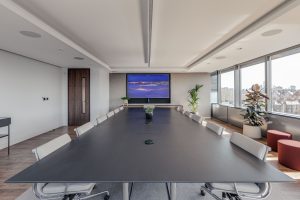
In 2026, the smartest move in real estate is often not to move at all. Across London and the UK, we are witnessing a strategic shift where leading organisations are choosing to revitalise rather than relocate. They are unlocking immense value – commercial, cultural, and environmental – by reimagining the asset they already hold.
The Evolution of the “Stay” Decision
Why is this shift happening? First, the economic argument is undeniable. Relocation is an incredibly expensive exercise, involving agent fees, legal costs, stamp duty, dilapidations on the old lease, and the premium rents of a new Grade A building. By refurbishing, you avoid these “dead costs” and direct your capital entirely into the thing that matters: the environment your people experience every day.
Second, the environmental imperative has changed the rules. As ESG (Environmental, Social and Governance) moves to the top of the corporate agenda, the carbon cost of moving is under scrutiny. The most sustainable building is the one that already exists. By retaining your current shell and upgrading the mechanical infrastructure, you can drastically reduce the “embodied carbon” of your workplace strategy compared to a new build.
However, the primary driver for refurbishment is not cost or carbon; it is function. Since 2020, the way we work has changed profoundly. For a while, remote working was framed as the enemy of the office. Today, the conversation has settled into something more nuanced. The office is not dead – but the old office is obsolete.
If your current workspace consists of rows of assigned desks and a few glass meeting rooms, it is designed for a world that no longer exists. Today’s office must earn the commute. It must be a destination that offers what the home cannot: spontaneous collaboration, cultural immersion and high performance infrastructure
Many business leaders look at their empty desks on a Friday and assume they have “too much space.” Often, they don’t have too much space; they have the wrong kind of space. A strategic refurbishment allows you to rationalise that square footage – trading under-utilised desk farms for social hubs, zoom-enabled booths and wellness zones – without the disruption of a physical move.
You May Also Like
The Role of Technology in Modern Workplace Design
15th June, 2026
Building a Strong Company Culture in the Age of Hybrid Work
1st June, 2026
Glossary
22nd March, 2026
Your Estate Is Your Strongest Recruitment Asset
16th March, 2026
Working With Maris
13th March, 2026
Why Relocate?
9th March, 2026