
Your Estate Is Your Strongest Recruitment Asset
16th March, 2026
WHERE DIGITAL PROMISE MEETS PHYSICAL REALITY
Student recruitment is no longer a linear process; it is a highly complex, digital-first journey.
Today’s prospective students belong increasingly to what behavioural researchers describe as Generation C (Connected): audiences shaped by continuous access to search, social, mobile and AI-enabled decision making. Increasingly, students rely on search everywhere optimisation and immersive digital channels to evaluate institutions, with 60% now utilising AI chatbots during their research journey.
However, while your digital marketing and automated enrolment funnels may secure the initial inquiry, the final commercial decision is still overwhelmingly influenced by the physical reality of the campus.
The stakes for physical conversion have never been higher. With the introduction of the 20% VAT levy pushing independent day school tuition to an average of £18,456 annually, the cost of education is approaching the upper threshold of what many families consider commercially viable. Simultaneously, higher education continues to battle a catastrophic 6.8% drop in overseas postgraduate enrolments, representing an instant and irreplaceable loss of roughly 25,000 high-fee paying students.
Hyper-connected prospective families do not view digital marketing and physical campuses as separate experiences – they experience them as one continuous narrative.
If a slick digital campaign promises a cutting-edge, future-ready environment but the campus tour reveals tired classrooms, outdated arrival spaces or uninspiring social areas, a severe value gap instantly opens. The physical estate becomes evidence either for – or against – the promise being made.
Student experience is therefore no longer a secondary consideration. Campus environment is increasingly linked to belonging, satisfaction, engagement and academic performance. Institutions that fail to align their physical environments with their market positioning risk losing applicants long before an offer decision is made.

THE MARIS METHODOLOGY:
ADMISSIONS PATHWAY ENGINEERING
You cannot fix a broken admissions journey by simply painting the reception area. We treat the prospective parent and student journey as a choreographed commercial sequence, reverse engineering the physical route to ensure every touchpoint accelerates the decision to enroll. We execute absolute Environmental Congruence across three controlled components:
Component 1: The Arrival Vanguard & Sightline Audit
The first 60 seconds on campus establish expectations for the entire relationship. We physically map open-day routes and audit transitional sightlines to engineer visual moments that reinforce academic excellence. Administrative reception barriers are replaced with hospitality-led arrival experiences that eliminate aesthetic disconnects and immediately validate value.
Component 2: Subconscious Materiality & The Sensory Audit
A visually impressive space still fails if it overwhelms the senses. We evaluate visual noise, acoustic zoning and environmental comfort to ensure the campus experience accommodates neurodiversity and reduces cognitive load. Material selections are designed to express institutional identity while maintaining commercial discipline and long-term durability.
Component 3: The Digital-Physical Bridge
If online marketing promotes a future-ready education, physical environments cannot feel disconnected from that promise. We align architecture, technology and experience so admissions suites and learning environments consistently project safety, hospitality and digital integration.
THE ADMISSIONS LEADER’S CORNER:
PLUGGING THE LEAKY FUNNEL
Empirical data confirms that campus open days remain the most effective recruitment interventions available to educational institutions. For Directors of Admissions, the physical estate is therefore the most powerful conversion tool at your disposal.
Institutions invest heavily in digital acquisition, enquiry generation and social campaigns – but if the estate functions as a leaky funnel during campus visits, that investment is diluted at the final stage of conversion.
When an admissions team is forced to lead a family through a tired, legacy building, the perceived value of the institution drops regardless of published academic outcomes. A high performance physical environment actively defends your premium fee structure and removes friction from the sales conversation, allowing admissions staff to focus on academic excellence rather than apologising for outdated facilities.

MARIS TOOLS:
THE CONVERSION DIAGNOSTICS
To stop recruitment spend leaking through the physical estate, replace anecdotal guesswork with targeted, data-driven diagnostics. Do not authorise capital expenditure without addressing your conversion friction using these instruments:
1. Student Journey Mapping: A spatial analysis tracing the exact physical footsteps of a prospective family. It locates the precise aesthetic disconnects destroying brand trust between the arrival gates and the admissions suite, directing your capital only to the areas that actively drive recruitment.
2. The Campus Experience Index: A diagnostic benchmarking tool that compares your tour route facilities against a global database of urban campuses. It mathematically proves whether your social and informal spaces are actively losing applicants to competitor institutions.
3. The Sensory Audit Checklist: A rigorous acoustic and visual evaluation ensuring the environment accommodates neurodiversity. It actively reduces cognitive load during the high-pressure admissions conversation by mandating the provision of low-stimulation zones and intelligent acoustic dampening.
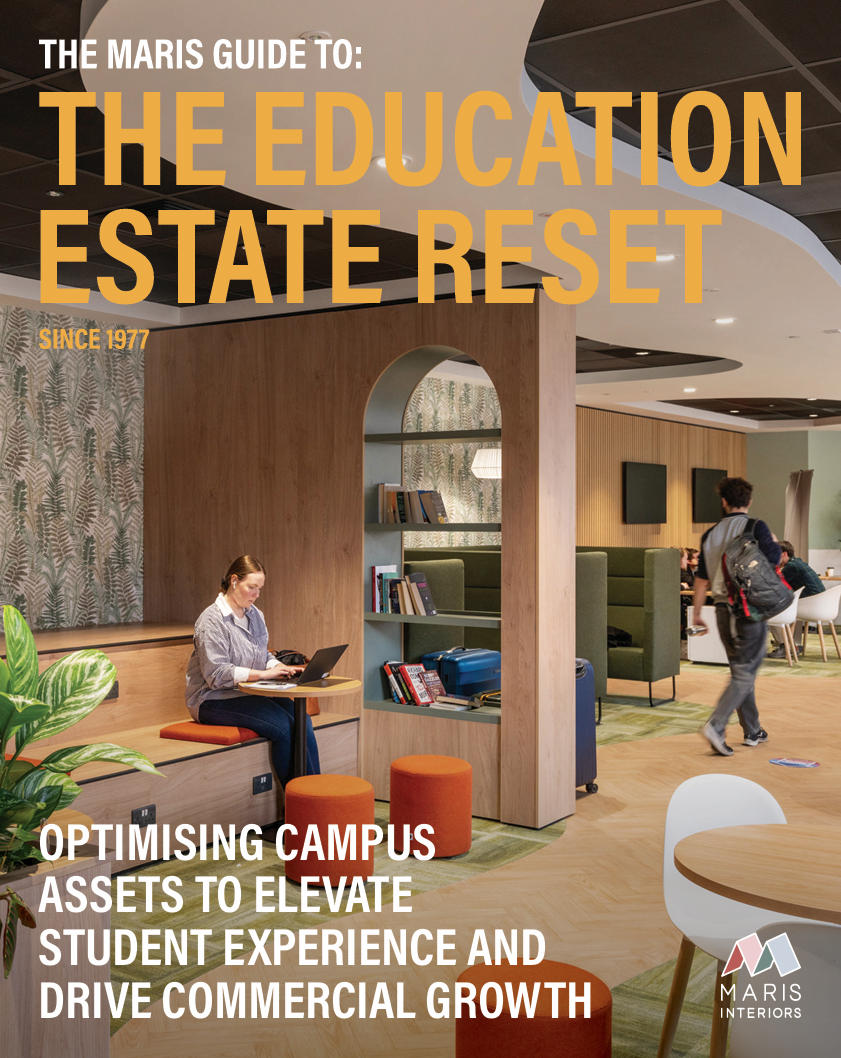
You May Also Like
The Role of Technology in Modern Workplace Design
15th June, 2026
Building a Strong Company Culture in the Age of Hybrid Work
1st June, 2026
Glossary
22nd March, 2026
Working With Maris
13th March, 2026
Why Relocate?
9th March, 2026
What Leading London Firms Are Doing Differently
4th March, 2026