
How to Maximise Your Office Space and Make It Work for You
23rd May, 2025
Office space is one of the most significant investments any organisation makes. It’s a fixed cost that needs to justify itself, not just in terms of capacity, but in how effectively it supports your people, your culture and your long-term growth.
Having enough desks and meeting rooms is only part of the equation. The real value comes from how well that space performs – supporting productivity, wellbeing and talent attraction.
At its core, maximising office space works on two levels: ensuring your space isn’t wasted, and ensuring it works as hard as possible.

Flexible working has given many organisations the opportunity to rethink the way they use their offices, and in lots of ways it’s challenged our thinking so that we use space better.
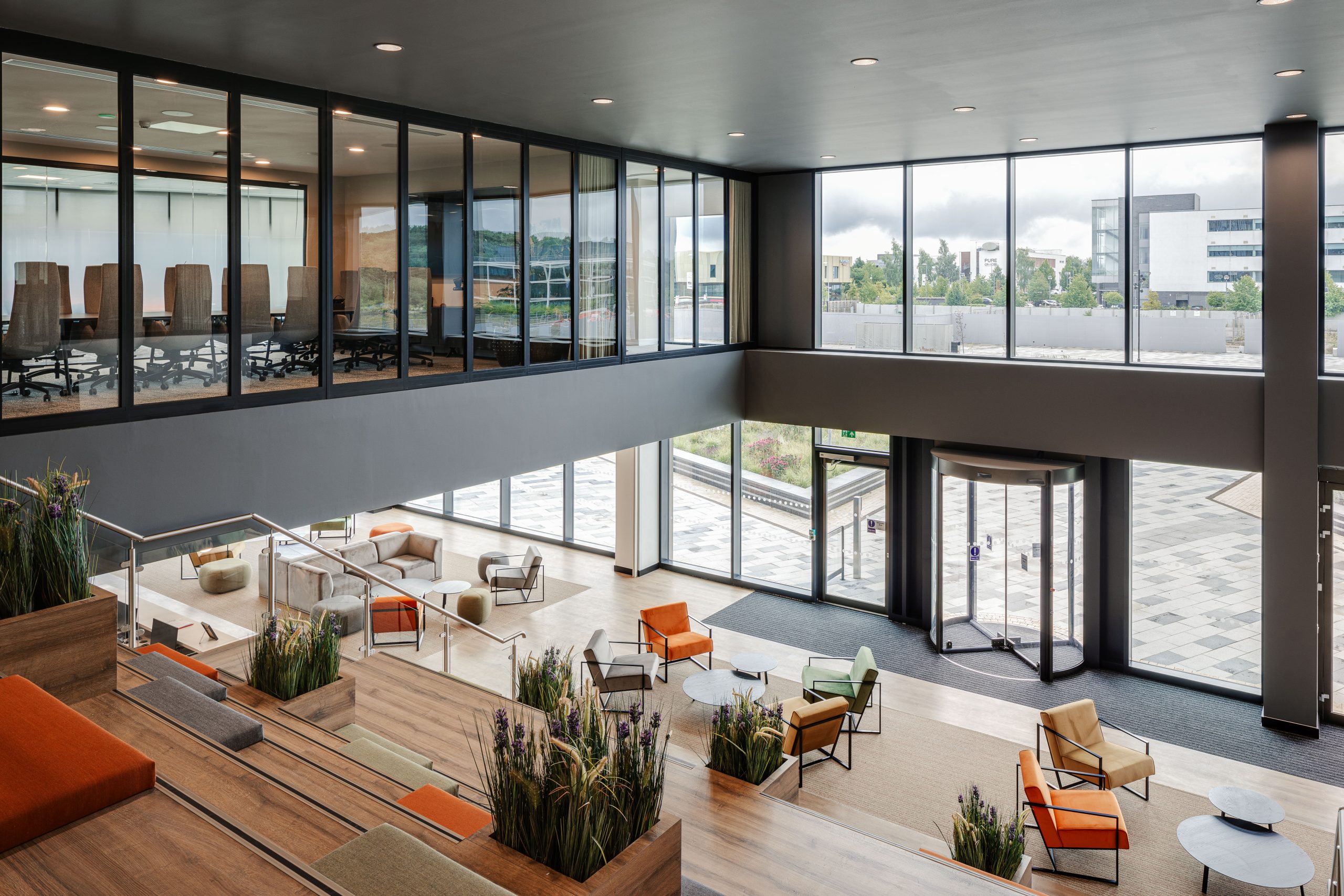
For some, like our client JTI, this has meant moving away from large, underutilised suburban offices to smaller, more central locations. By shifting investment from quantity to quality, and aligning space with how it’s actually used, they’ve created a more premium, wellbeing-focused environment that better supports their team and strengthens their appeal to new talent, as reflected in the workspace shown above.
Space Planning: The Foundation of Performance
Maximising your office space starts with understanding exactly what you need from it – both now and in the future.
That means looking beyond headcount and asking more fundamental questions:
- What tasks are being carried out?
- How do teams actually work together?
- What tools and environments do they need?
- How might this evolve over the next three to five years?
This level of planning is what turns space from a cost into a strategic asset.
For example, when working with a world-leading consultancy firm, the challenge was to accommodate 60 offices, 14 meeting rooms and three boardrooms within a constrained footprint, while ensuring every office delivered a consistent, bookable experience.
Rather than relying on a rigid grid of fully enclosed rooms, we created a series of standalone cellular offices defined by glazed partitions and acoustic separation, with ceiling “lids” that allowed building services to run above without dropping full-height bulkheads. This avoided a heavy, box-like feel and gave greater flexibility in how the space was organised and experienced.
The result was a highly efficient layout that met a complex brief, while still feeling open, connected and easy to navigate.
Designing Around How Your Office Actually Works
Concepts like hot desking and agile working are often seen as solutions in themselves. In reality, they only work when they’re built on a clear understanding of how your organisation operates day to day. Without that, they quickly become friction points.
When JTI moved away from a 1:1 desk ratio, the focus wasn’t just on reducing desks – it was on ensuring the new environment genuinely worked for their teams.
We developed a model where teams come into the office on shared days, supported by dedicated “pods” within an open-plan space. Each pod includes:
- Hot desk settings
- Phone booths for private calls
- Informal collaboration areas
- Meeting rooms and social touchpoints
Alongside this, central locker points on each floor allow staff to store personal belongings securely, while a strict clean desk policy and document digitisation process eliminates physical paper clutter.
The result is a space that feels structured and intuitive, rather than uncertain or overcrowded.

Multifunctional Workspaces: Making Every Space Count
A critical part of making the most of your space is identifying areas that aren’t used all the time – and designing them to do more.
With the right approach, spaces like boardrooms, meeting suites and breakout areas can serve multiple purposes without compromising on quality or experience.
Large meeting rooms, for example, can be divided using moveable walls to create smaller spaces when needed. With the addition of modular furniture, integrated AV and considered storage, they can also double as town hall spaces or event venues.
This thinking needs to happen early in the design process, right down to technical details like power, acoustics and joinery.
Arrival Space:
When working with global tech company MSQ, we reimagined the traditional tea point as a standout coffee bar that also functions as the main reception. Positioned at the front of the office, it creates an immediate sense of arrival and energy. Behind it, a custom-built, low-level bleacher seating area wraps the space, providing a flexible setting for team meetings, presentations and informal breakout use.
Moveable Walls:
In some cases, maximising space comes down to creating highly tailored, multi-purpose solutions. In another project for a retail-led organisation, we designed a moveable, multi-purpose structure that acts as a partition wall, product display system, tiered seating for presentations and an integrated storage solution. This allows the space to adapt continuously to product launches, events and day-to-day working – without requiring constant reconfiguration.
Modular Furniture:
Similarly, for a leading law firm, we created a flexible meeting suite that can transition into a social space through the use of moveable walls, varied seating and a dedicated front-of-house catering pantry.
In each case, the principle is the same: no space should sit idle if it can be designed to do more.

Planning for Growth, Not Just Today
Beyond day-to-day efficiency, the most effective offices are designed to evolve. One of the most common challenges organisations face is creating an office that works now, but won’t need to be completely redesigned in a few years’ time. The answer is to build flexibility into the design from the outset. This means creating spaces that feel complete and purposeful today, while still allowing for future expansion. It’s not about leaving areas empty – it’s about designing them to evolve.
Making Your Office Work Harder
When people think about maximising your office space, the focus is often on aesthetics. But the real impact comes from a deeper understanding of how space, people and business objectives connect.
Get that right, and your office becomes more than a place to work – it becomes a tool for performance.
At Maris, we take the time to understand how your organisation operates today and where it’s heading next. That’s how we ensure your space isn’t just efficient, but genuinely effective – supporting your team, your culture and your long-term success.
Want to Maximise Your Office Space?
Speak to our team to understand how your current space is performing, and where it could work harder.
You May Also Like
Turn Strategy Into a Workplace Brief
17th July, 2026
Negotiation Is About Leverage, Not Discounts
17th July, 2026
Commercial Control Before Construction Starts
16th July, 2026
The ‘Day One Readiness’ Walkthrough
16th July, 2026
Protecting Your Real Estate Strategy
15th June, 2026
The Role of Technology in Modern Workplace Design
15th June, 2026