
Designing A Magnetic Workplace
18th April, 2025
EXPERIENCE OVER EFFICIENCY
Returning to the office only works if people genuinely want to be there.
THE SHIFT TO EXPERIENCE
This means designing environments that go beyond the functional to become “magnetic”.
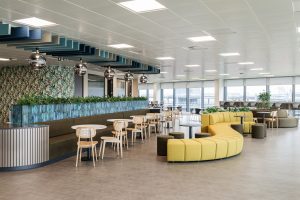
For decades, traditional offices were designed around efficiency metrics: How many desks can we fit? How much does it cost per square foot? In 2026, magnetic workplaces flip that script. The question becomes: “What do our people need to thrive?”. This is the era of Experiential Design. It draws from hospitality, retail and psychology to create a space where people linger, connect, and contribute, rather than just arrive, work and leave.
As the guide notes, “The space becomes a contributor to energy – not a drain on it”. To earn the commute, the office must offer what the home cannot: distinct zones for deep focus, creative friction and social restoration. If the office experience feels transactional, attendance will remain low. If it feels relational and energising, attendance becomes voluntary.
THE MARIS METHODOLOGY:
MAKING IT MAGNETIC
At Maris, we treat workplace design as a strategic tool, not just an aesthetic one. Our methodology avoids “design by committee,” which often results in generic outcomes. Instead, we use a process of deep listening and environmental congruence.
1. Timing is Leverage:
We encourage clients to benchmark their office against members’ clubs, not other offices. This isn’t about luxury; it is about “care”. High-quality lighting, scent, acoustics and warmth signal that the employee is valued.
2. Human-Centred Zoning:
We move away from density-driven planning. Instead, we design for flow. We create distinct zones:
- Focus Zones: Acoustically protected areas for deep concentration.
- Collaboration Areas: Flexible spaces with writable surfaces for co-creation.
- Decompression Spaces: Biophilic zones for recovery and mental rest.
3. Brand in 3D:
We ensure the space tells a story. “The best brand expression is subtle but strategic… in the rhythm of the space.”
THE CFO’S CORNER:
BUILDING FOR BELONGING
In the post-pandemic workplace, one of the most valuable currencies is belonging. When employees feel like they are part of something meaningful, performance improves.
- The Concept: Belonging cannot be mandated. It must be cultivated through “environmental congruence” – spaces that feel inclusive and aligned with employee identity.
- The Action: Leaders must ensure the office reinforces belonging through sensory and social cues. From how teams are clustered to where social space is located, every detail can either promote or erode connection.
- The Return: When employees see themselves reflected in their environment, they feel seen. “And when they feel seen, they show up”. This is critical for Diversity, Equity, and Inclusion (DE&I); providing acoustic pods for neurodiverse staff or clear wayfinding for introverts signals that the workspace is for everyone.

You May Also Like
The Role of Technology in Modern Workplace Design
15th June, 2026
Building a Strong Company Culture in the Age of Hybrid Work
1st June, 2026
Glossary
22nd March, 2026
Your Estate Is Your Strongest Recruitment Asset
16th March, 2026
Working With Maris
13th March, 2026
Why Relocate?
9th March, 2026